
Is 4 Hours of Sleep Enough? What Short Sleep Does to Your Recovery
/"I function fine on 4 hours."
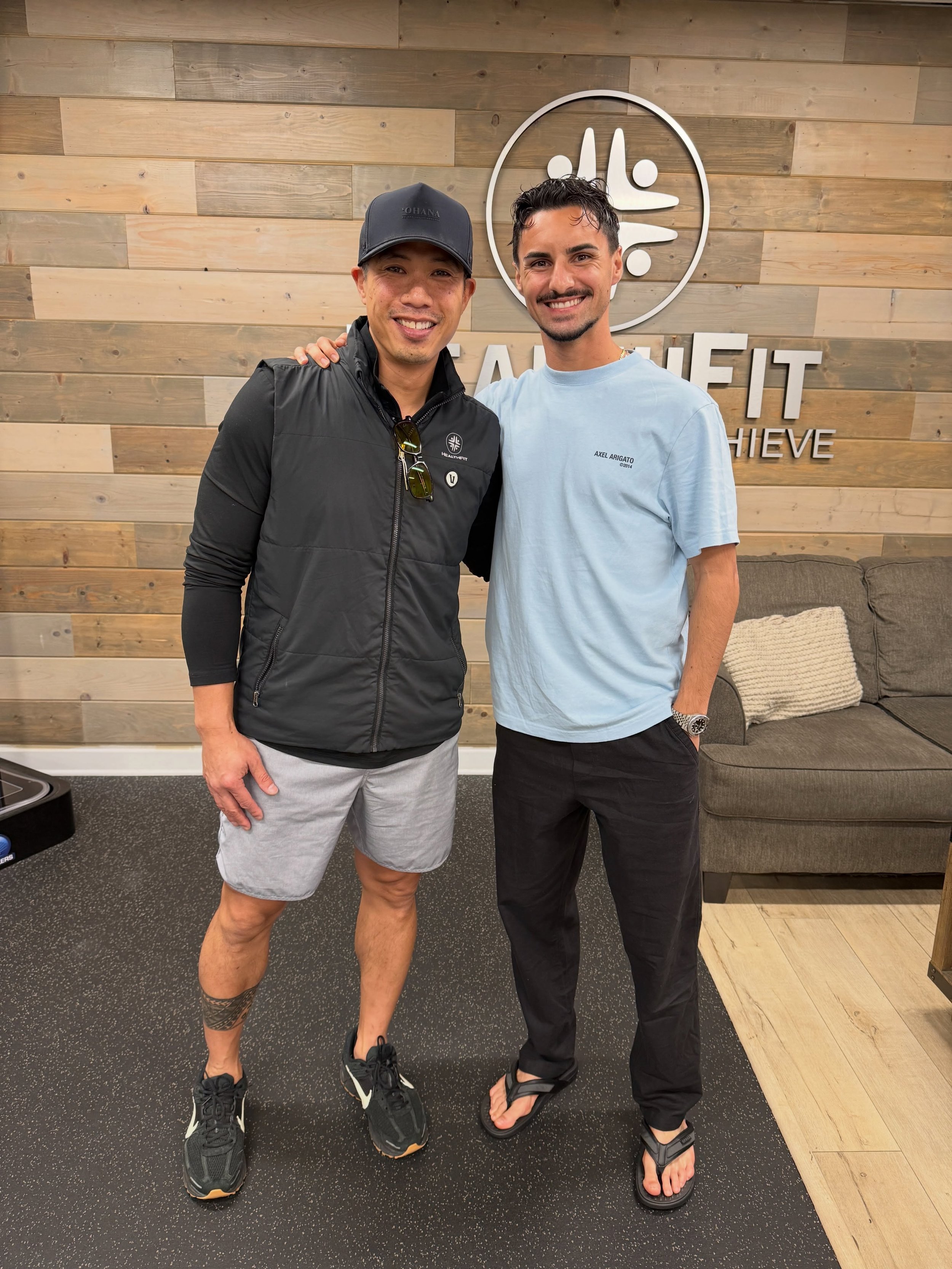
Our lead physical therapist, Dr. Cheri Chan, hears some version of that line every week. So does Allister Buchanan, our personal trainer (he calls himself HealthFit's "health and fitness sherpa," and his clients call him Coach B). In our latest HealthFit Huddle, the two of them sat down to talk about the thing that quietly decides whether your training pays off and whether your injury heals: sleep.
Can you really function on 4 hours of sleep?
You can get through the day. That is not the same thing as being rested.
Allister put it simply. A lot of people who say they are doing well on 4 hours are not running on rest. They are running on stress hormones. Cortisol is not the villain here. It is supposed to rise in the morning to get you going and fall in the evening so you can wind down. The problem is when it never gets the chance to fall.
The research backs up what Cheri and Allister see in the clinic. In a well known 2003 study published in the journal Sleep, researchers at the University of Pennsylvania limited healthy adults to 4, 6, or 8 hours of sleep a night for 14 days. The group sleeping 6 hours or less built up thinking and reaction deficits equal to up to 2 full nights without any sleep at all. The part that should get your attention: their own sense of how sleepy they were barely changed after the first few days. They felt about the same. They were not performing the same.
That is the trap. "I feel fine" is exactly what short sleep tends to make people say.
It is also common. According to the CDC, 30.5% of U.S. adults reported sleeping less than 7 hours a night in 2024. The American Academy of Sleep Medicine recommends at least 7 for healthy adults.
Why does short sleep make you hungrier?
Short on sleep, and suddenly you are raiding the pantry.
There is a real reason for that. Two hormones help steer appetite. Leptin is the "I'm full" signal. Ghrelin is the "I'm hungry" signal. A 2004 study in the Annals of Internal Medicine from the University of Chicago restricted healthy young men to 4 hours in bed for 2 nights. Their leptin dropped by 18%, their ghrelin rose by 28%, and their reported appetite went up by 24%, with the biggest cravings for sweets, salty snacks, and starches.
In other words, short sleep turns down the "full" signal and turns up the "hungry" one.
Deep sleep vs. REM sleep: which one helps you heal?
Allister does not care much about the single score your ring or mattress gives you. He cares about two things: how you actually feel when you wake up, and what kind of sleep you got.
Deep sleep is the physical recovery phase. It is when your body does much of its restoration and repair, and when your brain does a lot of its overnight cleanup of the waste that builds up while you are awake.
REM sleep is tied to memory, learning, and dreams.
Here is the detail that surprises people. Deep sleep is concentrated in the first part of the night. REM periods get longer toward the morning. So timing matters, not just total hours.
Allister shared the story of a client who was sleeping 8 to 9 hours but still waking up tired. His schedule had him going to bed around 2 or 3 in the morning and sleeping until 11. He was getting the length. He was not getting the quality. Shifting when you sleep changes what kind of sleep you get.
Why isn't my injury healing?
This is where it hits home for Cheri's patients. Someone is working a night shift, doing their exercises, showing up to every visit, and they come in frustrated: "I'm not getting any better. Just work me harder."
But working harder is only half the equation. As Allister put it, exercise is the stimulus. The actual growth and repair happen while you sleep. If you are shortchanging deep sleep, you are shortchanging the phase where much of the rebuilding takes place.
That is why, at HealthFit, sleep is part of the conversation in physical therapy and personal training, not an afterthought. We look at what you do from about 7 PM on, what time you go to bed, and what time you get up, the same way we would look at how you move.
What if I wake up at 3 AM and can't fall back asleep?
Allister finds that most of his clients do not have trouble falling asleep. They have trouble staying asleep. Usually the cause is what he calls mental arousal: your brain starts working through tomorrow's list at 2:15 in the morning.
What helps, in his experience:
Write it down before bed. Make a quick list of what is on your mind and what you need to handle tomorrow. Clients who were skeptical told him they drifted back to sleep more easily. The mind quiets down once it knows there is a plan.
Do not check your phone. The moment you see the time, you start doing math about how many hours you have left, and that math wakes you up more.
Breathe, and be gentle with yourself. Box breathing is one simple option. Stay in bed, keep the lights off, and do not grade yourself on how fast you fall back asleep.
On supplements like melatonin or magnesium, both Cheri and Allister keep it simple: build the habits first, and talk with your own provider before adding anything.
When is it more than a bad habit?
Allister shared something personal in this Huddle. He snored for most of his life and was not diagnosed with sleep apnea until he was about 50. His first attempts with a CPAP machine did not stick. What finally did was a promise to himself that he wanted to be around for his daughter's wedding someday. He found a setup that fit, stuck with it, and now does not even notice it.
If you snore loudly, or your partner tells you that you stop breathing at night, bring it up with your doctor. That is a conversation for a medical provider, not a wearable.
4 sleep habits you can start tonight
Cheri asked Allister for steps anyone can use, not just "go to bed earlier." Here is his list:
Get a baseline. A wearable can show you how much deep sleep, REM sleep, and awake time you actually get, and how long it takes you to fall asleep. Allister wears a Whoop and an Oura ring himself. The point is data, not a particular brand.
Keep a consistent bedtime, and start winding down an hour before it. If you go to bed at midnight, start winding down at 11. Consistency matters even when the hour is late. If you have to be on screens at night, blue light blocking glasses are one tool Allister uses.
Stop eating about 2 to 3 hours before bed, and go easy on alcohol. Your body should be resting, not digesting. Alcohol in particular disrupts sleep.
Wake up at the same time every day, weekends included. Your internal clock loves consistency, and morning sunlight helps set it.
How HealthFit helps
Sleep is not a separate department at HealthFit. If you are here for an injury, it is part of your recovery plan. If you are training with Allister, it is part of your program. The goal is simple: give the work you put in a real chance to pay off.
If you have been stuck in your recovery, or you are ready to train with a coach who looks at the whole picture, start with a conversation with our team.
The bottom line
4 hours might get you through the day. Your body is keeping a different score. Protect your deep sleep, keep your schedule consistent, and give your recovery the same attention you give your workouts.
Watch the full HealthFit Huddle with Dr. Cheri Chan and Allister Buchanan here: [VIDEO URL]
HealthFit Physical Therapy & Chiropractic
145 Vista Ave, Suite 103, Pasadena, CA 91107
www.healthfitinc.com | 626-365-1380
Sources:
Van Dongen HPA, Maislin G, Mullington JM, Dinges DF. The cumulative cost of additional wakefulness: dose-response effects on neurobehavioral functions and sleep physiology from chronic sleep restriction and total sleep deprivation. Sleep. 2003;26(2):117-126. pubmed.ncbi.nlm.nih.gov/12683469/
Spiegel K, Tasali E, Penev P, Van Cauter E. Sleep curtailment in healthy young men is associated with decreased leptin levels, elevated ghrelin levels, and increased hunger and appetite. Annals of Internal Medicine. 2004;141(11):846-850. pubmed.ncbi.nlm.nih.gov/15583226/
CDC National Center for Health Statistics. Short Sleep Duration and Sleep Difficulties Among Adults: United States, 2024. NCHS Data Brief No. 559. cdc.gov/nchs/products/databriefs/db559.htm
National Institute of Neurological Disorders and Stroke. Brain Basics: Understanding Sleep. ninds.nih.gov/health-information/public-education/brain-basics/brain-basics-understanding-sleep
The information in this article is intended for general guidance only and should never be considered a substitute for professional medical advice, diagnosis, or treatment. Always seek the advice of your physician, medical provider, or physical therapist with any questions regarding a medical condition. Individual results vary.