Plantar Fasciitis: Why It Keeps Coming Back (And How to Actually Fix It)

Plantar Fasciitis: Why It Keeps Coming Back (And How to Actually Fix It)

If your plantar fasciitis keeps coming back after rest, stretches, orthotics, and cortisone shots, you're not unlucky — you're undertreated. Chronic plantar fasciitis isn't primarily inflammation anymore. It's tissue degeneration, which means anti-inflammatory strategies are treating the wrong problem. At HealthFit in Pasadena, Dr. Jason Han traces the real cause chain from your heel all the way up to your hip — restricted rear foot mechanics, limited ankle dorsiflexion, reduced big toe mobility, tight calves, and weak glutes all contribute to abnormal load on the plantar fascia. Using the Source-Cause-Stack, HealthFit runs regenerative therapy (EMTT, focused shockwave, and radial pressure wave) alongside hands-on physical therapy from Day 1 — healing the degenerated tissue at the cellular level while fixing the upstream movement patterns that broke it down in the first place.

Read More

Hip Bursitis or Something Else? The Real Reason Your Lateral Hip Pain Won't Quit

Hip Bursitis or Something Else? The Real Reason Your Lateral Hip Pain Won't Quit

If you've been treating hip bursitis for months and the pain keeps coming back after every cortisone shot and round of stretches, the diagnosis isn't necessarily wrong — it's just incomplete. The bursa is the smoke. The fire is upstream, in how your body moves. At HealthFit in Pasadena, Dr. Jason Han evaluates the three conditions that hide behind the same lateral hip pain — glute medius tendinopathy, hip impingement, and lumbar referral — and traces every one of them back to the movement system that's actually driving the friction. Using an integrated stack of hands-on care, corrective exercise, and regenerative therapy with EMTT, focused shockwave, and radial pressure wave from Day 1, the goal isn't just calming the bursa temporarily. It's fixing the hip drop, the dynamic valgus, and the upstream weakness that started the whole pattern — so the smoke finally clears for good.

Read More

Why Your Ankle Sprain Isn't Healing — And What Real Recovery Looks Like

Why Your Ankle Sprain Isn't Healing — And What Real Recovery Looks Like

Up to seventy percent of ankle sprains never fully heal — not because people skip rehab, but because the rehab they get only treats half the problem. When you roll your ankle, the ligament tears and the nerve sensors inside it get damaged, which is why the ankle keeps giving out months or years later. What most clinics miss is even subtler: the fibula often shifts slightly forward during the sprain, quietly limiting your dorsiflexion and throwing off your squat, your gait, and your loading mechanics for years. At HealthFit in Pasadena, Dr. Jason Han treats both layers — rebuilding proprioception, hip strength, and movement patterns while using EMTT and focused shockwave to directly heal the damaged ligament tissue from Day 1. Three weeks on a wobble board isn't ankle rehab. Treating the source and the cause together is.

Read More

Why Stretching Isn't Fixing Your Tight Hips (And What Will)

Why Stretching Isn't Fixing Your Tight Hips (And What Will)

If you stretch your hips every morning and they're locked up again by lunch, you're treating the symptom — not the cause. Chronic hip tightness is rarely a flexibility problem. It's usually a strength and stability problem: weak glutes that stop firing, a core that can't stabilize the pelvis, and four hip flexors working overtime to compensate. At HealthFit in Pasadena, Dr. Jason Han uses a Source-Cause framework to identify what's actually driving the tightness — whether it's posterior chain weakness, core instability, or real joint degeneration like a labral tear or hip impingement. When tissue damage is part of the picture, regenerative therapy with EMTT, focused shockwave, and radial pressure wave is integrated from Day 1 alongside hands-on care and corrective exercise. You can't out-stretch a weak posterior chain — but you can fix the whole system when you treat the source and the cause together.

Read More

Focused vs. Radial Shockwave: Why One Machine Isn't Enough

Focused vs. Radial Shockwave: Why One Machine Isn't Enough

Most people who say shockwave therapy "didn't work" never learned there are two kinds — and they only got one. Focused shockwave delivers concentrated acoustic energy deep into damaged tissue like arthritic joints, bone stress injuries, and tendon insertions. Radial pressure wave spreads energy across the surface to release the tight muscles, compensating structures, and overloaded soft tissue that caused the injury in the first place. At HealthFit in Pasadena, we use the Storz Medical system with both machines running together from Day 1 — because treating the source without addressing the cause, or vice versa, leaves you with half a recovery. It's part of our Source-Cause-Stack framework: heal the damaged tissue, fix the movement pattern feeding it, and integrate regenerative therapy into the plan from the start — not as a last resort.

Read More

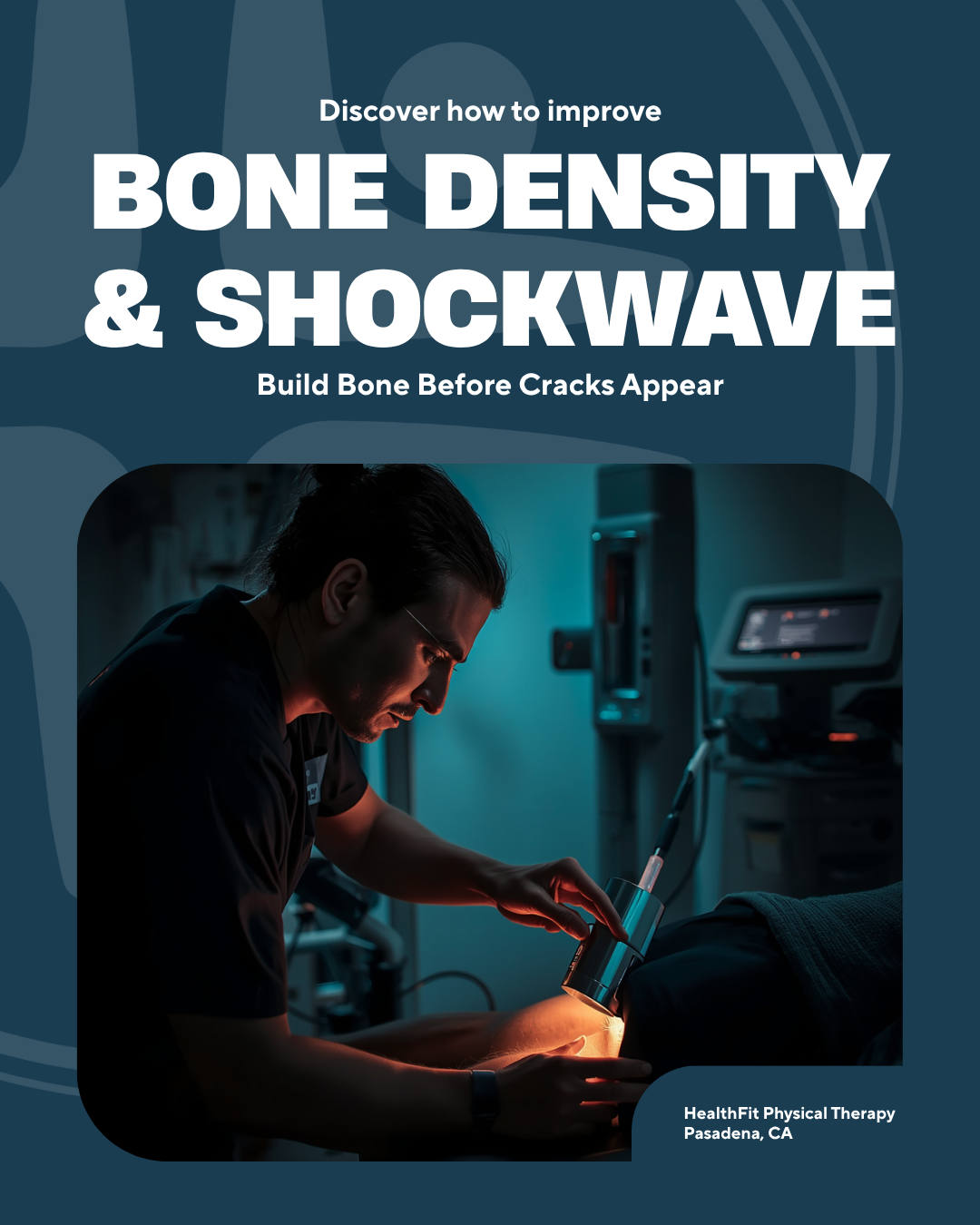
Shockwave Therapy & EMTT for Bone Density: What the Emerging Research Shows

Shockwave Therapy & EMTT for Bone Density: What the Emerging Research Shows

After age 40, most people lose about 1% of bone mass per year — and for postmenopausal women, that jumps to 2–3%. Calcium and vitamin D matter, but they don't address the root problem: dormant bone-building cells that have stopped receiving a strong enough signal to rebuild. Emerging research on focused shockwave therapy shows it can deliver a precise mechanical stimulus that reactivates osteoblasts and improves both bone mineral density and structural strength. When combined with EMTT — which primes the cellular environment and clears damaged cells before shockwave fires the rebuild signal — the regenerative stack targets bone health from two angles at once. Dr. Jason Han at HealthFit Physical Therapy in Pasadena walks through what the science shows, how the tendon-bone connection gets missed, and what a comprehensive bone health approach actually looks like.

Read More

When Cortisone Stops Working: What to Do Next

When Cortisone Stops Working: What to Do Next

The first cortisone shot worked. The second helped less. The third barely did anything. That's not a coincidence — repeat cortisone injections suppress the same inflammatory healing cascade your tissue needs to actually repair. Cortisone quiets the alarm, but it never fixes what's broken. At HealthFit Physical Therapy & Chiropractic in Pasadena, Dr. Jason Han uses what he calls the Regenerative Stack — EMTT to prime the tissue at a cellular level, focused shockwave to drive a precision healing signal into the damaged source, and radial pressure wave to address the surrounding soft tissue system feeding the injury — all while correcting the movement patterns that caused the problem. Here's why cortisone has a ceiling, and what comes next when you've hit it.

Read More

Storz Medical vs. StemWave vs. SoftWave: Which Shockwave Technology Is Right for You?

Storz Medical vs. StemWave vs. SoftWave: Which Shockwave Technology Is Right for You?

Not all shockwave therapy is the same. Storz Medical uses electromagnetic focused shockwave with a 2–3mm focal zone for laser-like precision. StemWave uses electrohydraulic technology with a broader focus. SoftWave spreads energy across the widest area with its parallel wave design. Each has clinical value — but the device is only half the equation. At HealthFit Physical Therapy in Pasadena, Dr. Jason Han sequences EMTT, focused shockwave, and radial pressure wave in a single session to address both the source of the injury and the cause behind it. Here's how the technologies compare and why clinical reasoning matters more than the machine.

Read More

What to Do Between Shockwave Therapy Sessions: The Recovery Protocol That Actually Heals

What to Do Between Shockwave Therapy Sessions: The Recovery Protocol That Actually Heals

Shockwave therapy has a 70–80% success rate for conditions like plantar fasciitis and tendinopathy — but only when the full recovery protocol is followed. What most patients don't realize is that the real healing happens between sessions, not during them. Icing, NSAIDs, and skipping appointments can cut your results in half by shutting down the very inflammatory cascade the treatment was designed to trigger. Dr. Jason Han at HealthFit Physical Therapy in Pasadena breaks down the exact between-session protocol — from active rest and controlled movement to hydration, sleep, nutrition, and fixing the upstream cause that created the injury in the first place.

Read More

EMTT vs Electrical Stimulation: The Fundamental Difference in How Healing Works

EMTT vs Electrical Stimulation: The Fundamental Difference in How Healing Works

Most people assume EMTT is just a newer version of electrical stimulation. It's not — they're in completely different categories. TENS and EMS send electrical current through surface electrodes to manage pain signals and activate muscles, but the current never reaches your tendons, ligaments, joints, or bone. EMTT uses high-frequency magnetic fields that penetrate deep into tissue at the cellular level — activating dormant repair genes, clearing senescent "zombie cells" that block healing, and triggering new blood vessel formation. One manages how you feel today. The other changes what's happening in your tissue. Here's why that distinction matters for anyone stuck in the chronic injury cycle.

Read More